
My Cart
0
You have no items in your shopping cart.
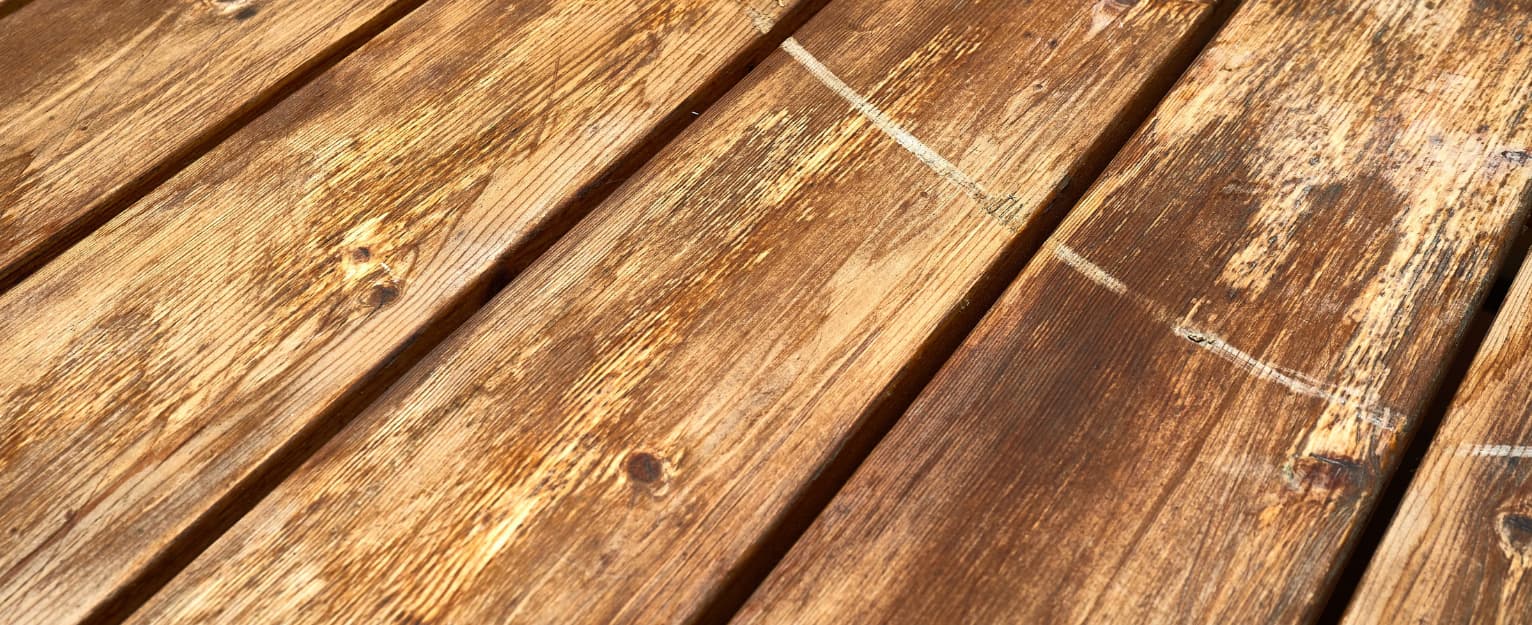
On the whole, it takes a lot to make a mark on composite decking. In fact, its famous durability is one of its main draws for buyers here at Savoy Timber, along with its longevity and its smooth contemporary style. But once in a blue moon, you might uncover an unpleasant surprise in the form of a scratch on your decking. Now as you’ve probably guessed already, it’s often an issue that requires a careful approach to make sure that you don’t make the problem worse. So, here are a few ideas you might want to consider – and one or two ideas you definitely shouldn’t!
Believe it or not, sometimes the best course of action is simply to do nothing, especially if the scratch off to one side, or in a corner, or some other relatively unobtrusive place. You might find that if it’s left alone for a bit, it can fade into the decking to the point where it’s barely noticeable, especially as composite decking exhibits a slight weathering effect under the elements.
If you can’t quite overlook it though, you might want to go for an alternative but equally simple solution – just rearrange your decking furniture to cover it up. It might not be the most sophisticated answer to the issue, but it’s definitely an effective one.

It’s worth checking who was the original manufacturer of your decking board, as that information can help you find out whether there are specific composite decking repair kits on the market that can help solve the issue. Repair kits typically utilise a wax or epoxy-based filler, which you can apply to the damaged board basically like wood putty.
If you’re going down that route though, you’ll first need to make sure that the damaged board is properly clean before you crack on with the kit’s first instructions. When you’re applying the filler itself, you can use a putty knife to smooth it out for a cleaner finish. Don’t forget to be quick in removing any excess wax.
If it’s a relatively shallow scratch, you may be able to use a composite repair marker pen. They’re fairly similar in principle to a shoe repair pen in that regard – you’re not removing the scratch so much as you’re making it very difficult to see. It might not be a perfect solution, but if the mark isn’t that deep to start off with, it might be all you need.

If your composite decking is a darker wood-grain shade, it may be worth considering certain wood stains. It’s a fairly popular solution for deeper scratches, as it handily protects the exposed elements of the boards too. Obviously, the ideal scenario would involve finding a shade of wood stain that matches the colour of your boards exactly, but if you’re not able to locate one, then you shouldn’t need to worry too much – the wood stain will fade and blend over time anyway, so it’s likely to naturally settle into the colour of your boards.
Some composite manufacturers supply their very own specialised ranges of wood stains for this exact scenario, so it’s worth looking up your composite decking’s manufacturer first and seeing what they suggest, before tracking down one yourself.
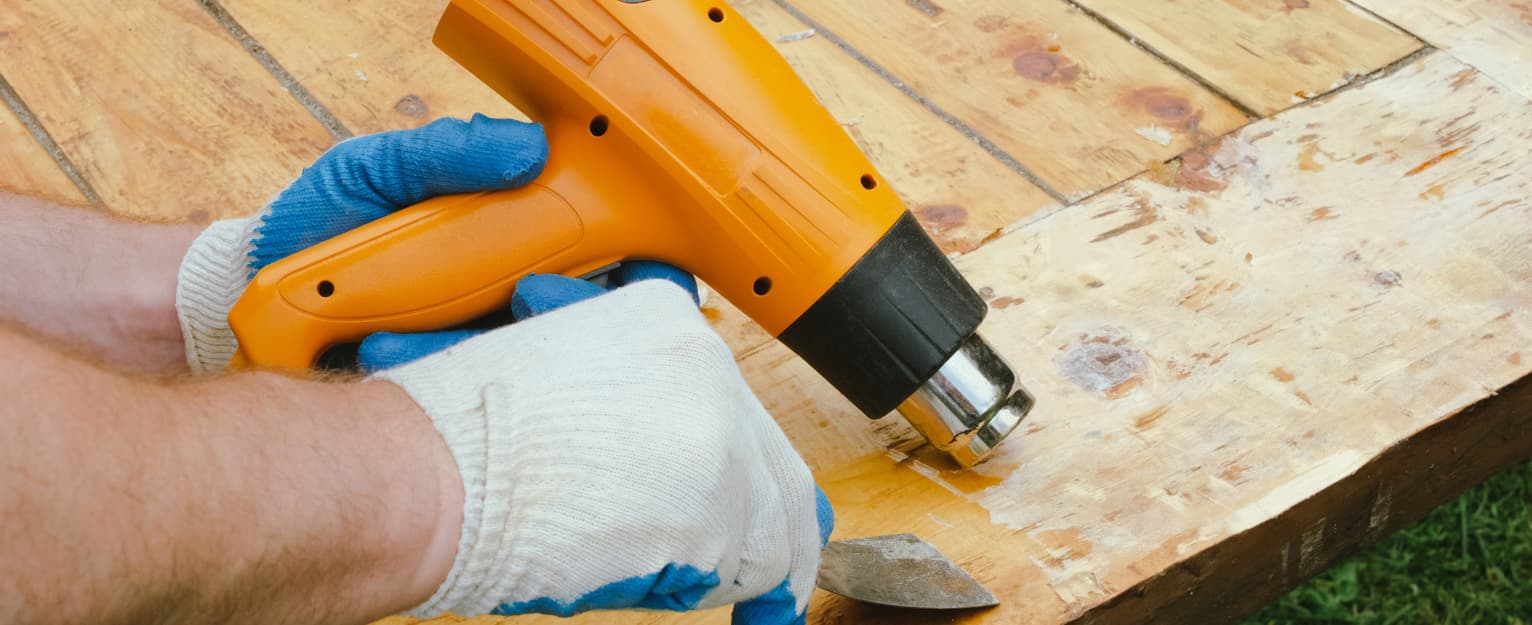
This is an idea that you might have heard proposed here and there, but to be honest it’s a relatively high-risk approach, so use with extreme caution. It’s very easy to get wrong, and it’s only going to work if the composite decking board itself is tolerant to high temperatures.
The execution is fairly simple in theory – you just need to hold the heat gun about six inches away from the affected area, and move it steadily back and forth until the mark starts to disappear. (You’ll need to be really careful not to hover too long in one spot, otherwise you can start to damage the board further.) With this, what you’re effectively doing is slightly softening the surface of your decking. You can then choose to leave it as it is, if the mark appears to be gone, or you can use a wire brush to blend it.
However, it’s worth repeating that there are a couple of different ways in which it could go wrong – you could accidentally hold the heat gun too long in one spot, or misjudge the heat and end up permanently discolouring your deck. One way to give yourself some peace of mind is to test it out on a sample board first – start at a lower heat, and then switch to a higher setting. That should give you a fairly decent idea of what kind of settings and techniques you’ll need.
If you’re at all unsure though, or you just can’t quite seem to nail it with the sample board, we’d suggest leaving it as it is. Unless, of course, you’re prepared to have to replace the board entirely if it goes wrong – in which case, you may decide it’s worth the risk.
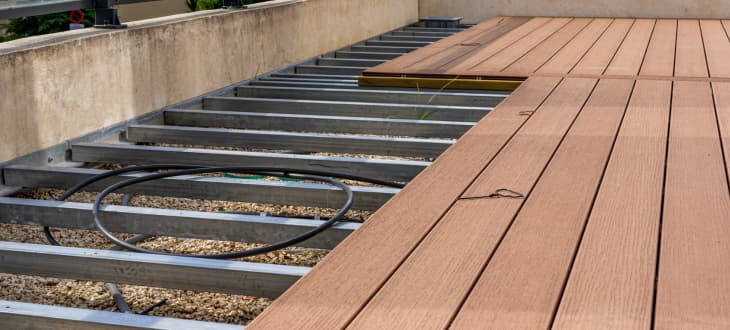
Finally, if it all goes pear shaped, or if the board is particularly badly damaged, or it didn’t quite go to plan with the heat gun, then there is at least one option you’ve always got left in your back pocket – and that’s simply to replace the decking board entirely. Ideally it shouldn’t come down to that, but if it does, just know that we’ve got you covered right here at Savoy Timber. We have a huge range of composite decking boards in a variety of shades and styles – and all at the very best prices.
In fact, we take care to stock everything you need to complete or repair your decking project, making us your one-stop shop for decking. If you fancy browsing our products for yourself, we have three DIY stores in Blackpool, Preston or Wigan. We’re dedicated to protecting our staff and customers in the midst of the current on-off government lockdown restrictions, so don’t forget to check our latest Covid-19 service update before you visit!

